US 30 Drag Strip [Hobart]
Description: Former Drag Strip
Location: 7920 Clay Street, Hobart, IN
Condition: Grass and Weeds
Originally Photographed: August 2001
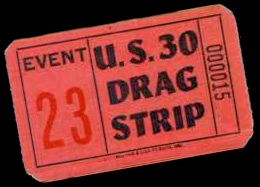
A ticket stub from the US 30 Drag Strip in Hobart, Indiana. All historical photos in this article courtesy of Gene Carlson.
Walking through a large grassy field, you stumble over a broken speaker. Wondering how such an item would end up in this odd spot, you look up to see two strips of weed-infested pavement stretching out a quarter-mile into the distance. Where once was heard the roar of the engine and the screaming of the crowd, now little more than the gentle breeze and the chirping bird is found at the site of the US 30 Drag Strip.
Almost since the invention of cars there’s been drag racing. For generations young boys have souped up their “hot rods” and challenged each other to tests of speed and courage from country roads to dry river beds.
By the 1950s, drag racing started to become more organized, largely due to the efforts of the American Hot Rod Association, created in 1956. Dirt fields sprouted bleachers and concession stands, and then beautiful paved tracks with safety fences and elaborate pit areas. Drag racing became big business.
Being a racing-crazed state, Indiana was not immune to this, and so a famous track was open by 1957, perhaps as early as 1954, in what is now Hobart, Indiana, just east of I-65 on the north side of US 30. Closed in 1984, the US 30 Drag Strip was top entertainment for scores of Northwest Indiana and Chicago residents, but now sits overgrown and broken down.

Gene Snow vs. Don Schumacher in 1972.
In the 1960s the owners discovered radio advertising, and they placed memorable ads primarily on WLS Radio in Chicago. An overexcited announcer would shout “Sunday! Sunday! Sunday! at the beautiful US 30 Drag Strip” and go on to announce the slate of stars on hand for that weekend. The announcer would then remind us in the same overexcited voice that the US 30 Drag Strip was “Where The Great Ones Run!”.
Truly the great ones did run here – every major racer in the sport ran down the strip, including “Big Daddy” Don Garlits, Don “The Shoe” Schumacher, and Chris “The Greek” Karamesines. Three generations of kids were permanently hooked on the sport by visiting the event just once. It was really a social gathering – not only were fans there to watch, but often to be seen in their own creations, worked on in garages and on driveways all week to make them ready for the “big show”.
The track was also the site of several major “firsts”. Ron Pellegrini claims to have run the very first “funny car” on the third weekend of May in 1965 at the US 30 Drag Strip. Characterized by a metal tube frame and a fiberglass body that can prop up or lift off the car entirely, this style car is popular to this day. Innovations continued, including replacing carburetors with fuel injection systems, replacing gasoline with nitro-methane, and adding turbochargers. Each year seemed to bring out new thrills as drag racing pushed the envelope of automotive innovation.

A view from the south side of the track looking at the starting line in 1972 and today.
No buildings remain except for the large barn across the street, now obscured by trees.
The twin paved strips run East-West in parallel to US 30 itself. Clay Street runs North-South along the East side of the property – the end nearest the street is where the starting line once was. The gigantic “pit” area was to the south of the track, and gravel parking lots for the fans were to the north. A small building stood at the head of the track east of the starting line, and a tall scoring and timing tower – painted orange for most of its life – stood at the starting line along its south edge.
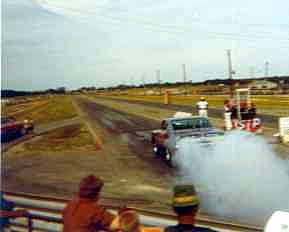
A view west down the track in 1972…

…and today.
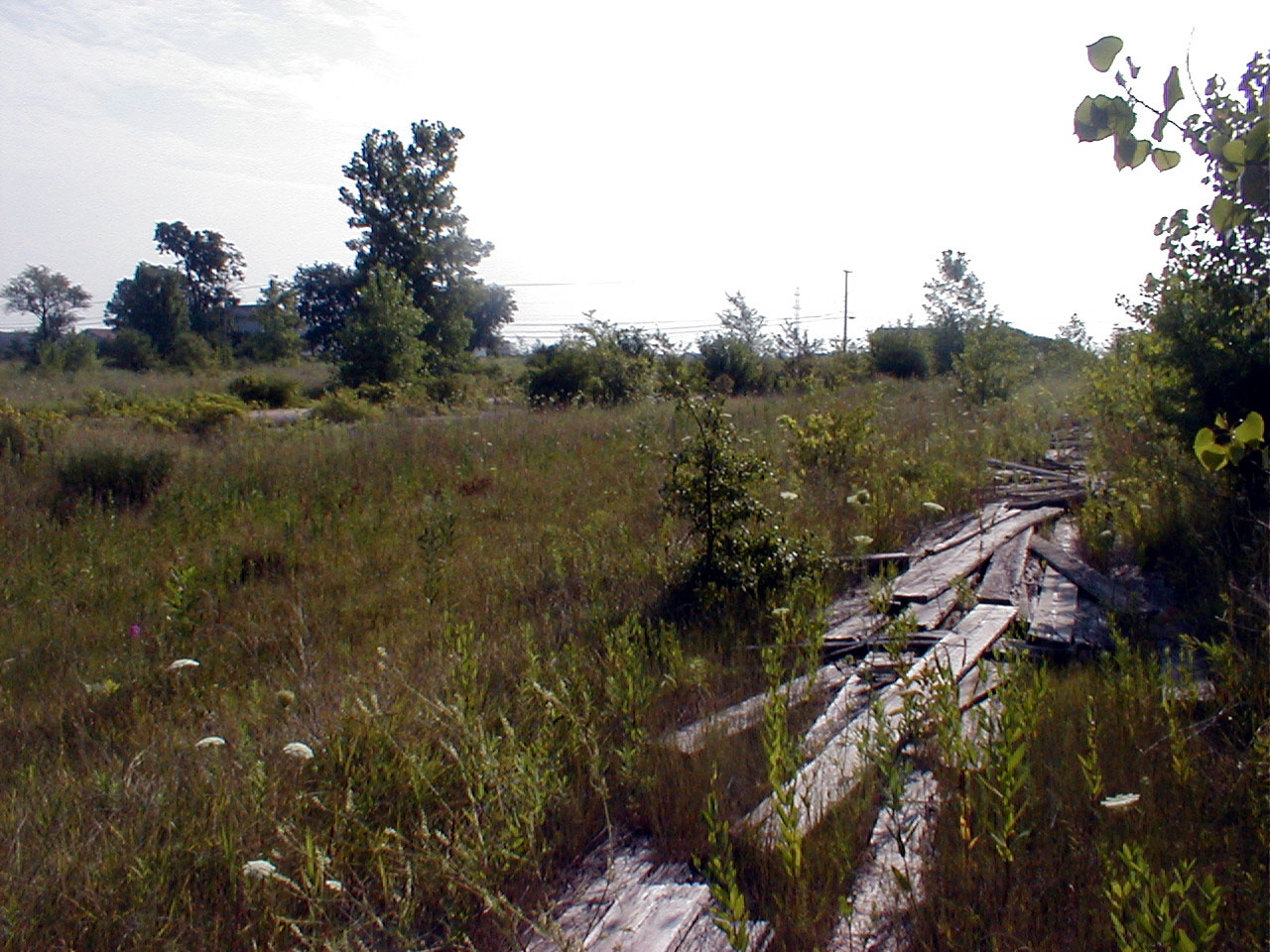
Today only one building remains – a small overgrown white wooden shack once known as the “Goodie Booth”, run by Mrs. Julie “Ma” Wright, who’s home was across Clay street from the pit entrance. The only other standing structures are some light/speaker poles dotting the landscape and a large broken-down set of bleachers, relocated from their original place at some point.

Someone moved and flipped the 1970s bleachers from their original place in the 1970s out to parking lot.

Piles of wood planks that made up the seats sit next to the metal frames rotting in the sun.
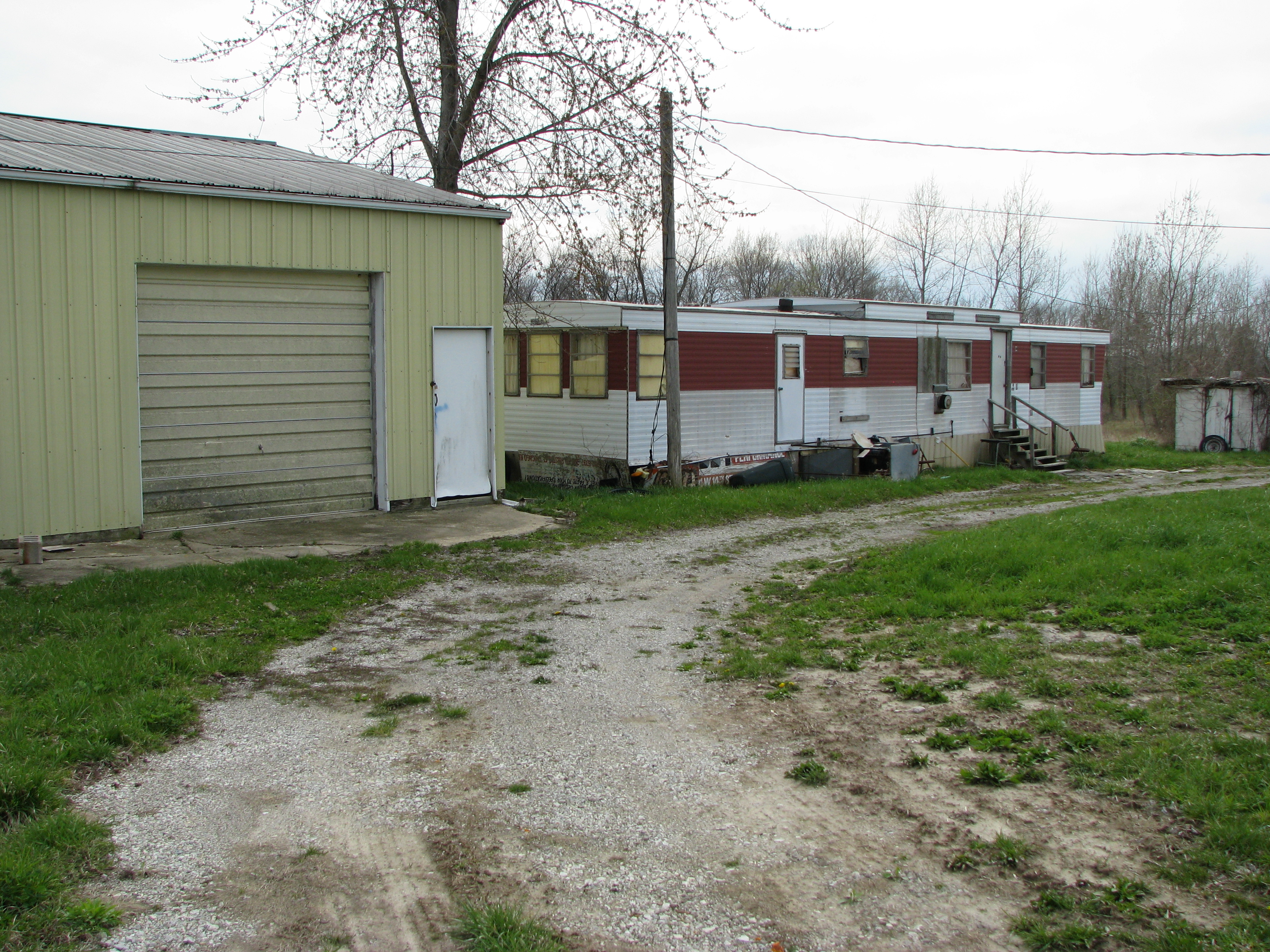
Large telephone poles block the obvious entrance to the facility behind the starting line, probably to discourage kids from using the track clandestinely for its original purpose. However, there is a way to enter the track grounds from what once was the pit area, as someone living in an old trailer now makes his home in the parking lot. Recently worn ruts leading from the pit lot on to the track area show that the owners of the land may not have been as successful at keeping people out as they hoped.

The pit area south of the track looking southwest next to the old tower in the 1970s…
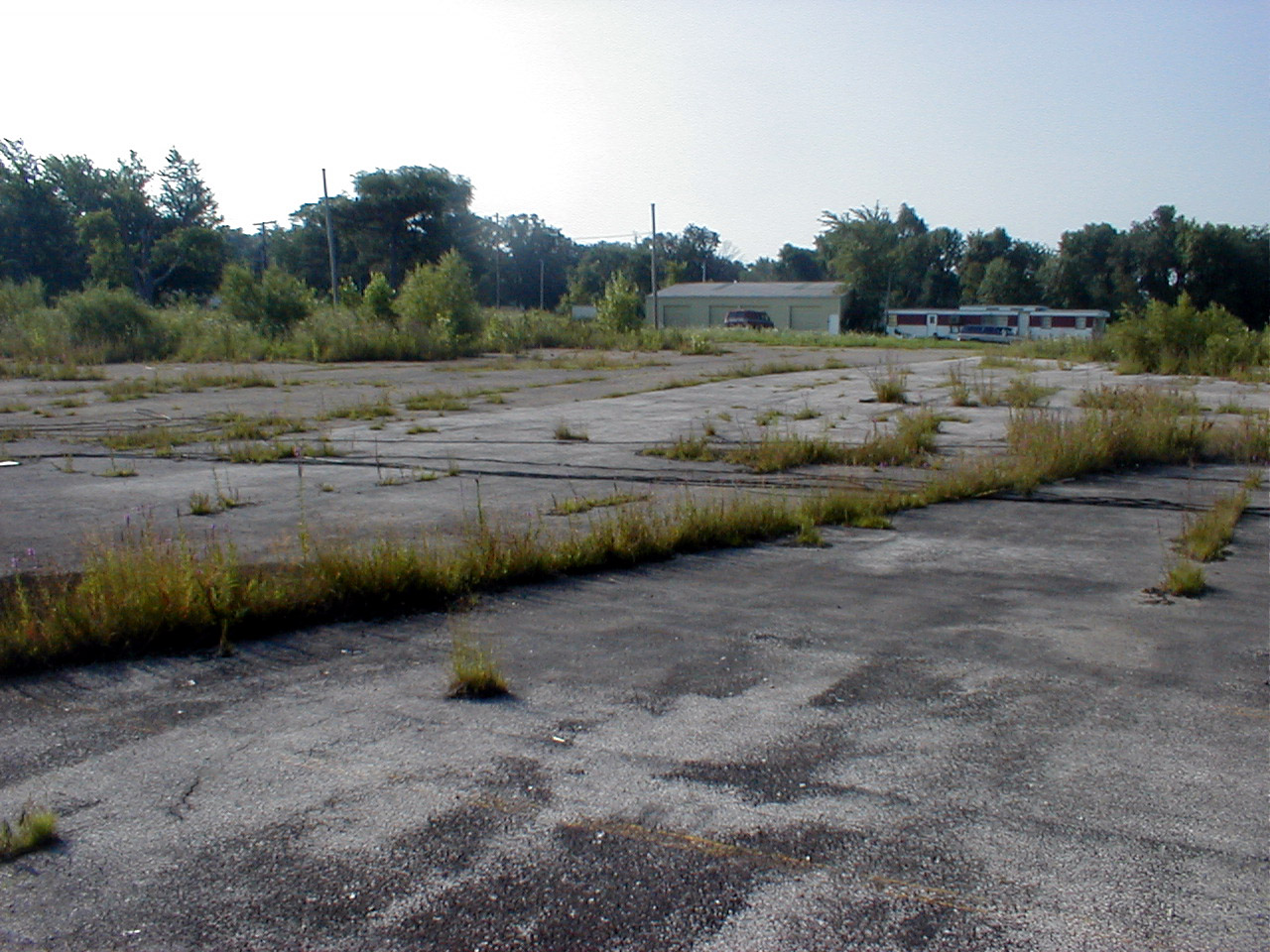
…and looking southeast from the same spot today. The trailer was home to Robert “Bobby” Kerr, night watchman and groundskeeper for over 35 years.
The track itself is hardly visible from the road due to the overgrown brush, but if one walks only a few feet on to the property from the east a vast unbroken stretch of pavement is clear in front of you. Though the starting lights are long gone, the original starting line is still faintly visible, and upon closer inspection, long streaks mark the concrete, a reminder of the hundreds of cars that were once launched from this point.

The remains of the “Goodie Booth” on the south side of the track…

…and inside. Part of a phone is on the wall, but only empty shelves are left.

The starting line, looking across both lanes. Click to zoom in to see the streaks still marked into the pavement.
The AHRA, who counted the US 30 as one of its flagship courses, created many of the rules and rules that now govern the sport, including a “points” system to decide the winner of a year-long series – a system that is the standard today in almost every form of auto racing. They also invented the “Christmas tree” starting lights which so many think of as the unofficial symbol of drag racing. However, by 1971 competition began to pinch the circuit, most notably by the now dominant National Hot Rod Association (NHRA). Even so, the AHRA circuit continued as popular alternative – especially for those who were around to witness the organized start of the sport.
The US 30 would meet its end in a rather unique way. The fiery Jim Tice had guided the AHRA from 1959 until his untimely death in 1982 from cancer. Ownership of the sanctioning body went to his wife, Ruth, and a battle for control of the circuit began. In the middle of the 1984 racing season, Mike Gray, the owner of Terminal Van Lines, approached Ruth. Mike offered to bankroll the circuit awards, and wishing for a sound future, Ruth sold. Stunned by the development, several track owners, including the US 30, split off to form the American Drag Racing Association (ADRA), and events were held at the facility for the rest of 1984 under that banner.

The AHRA logo painted on the pavement between the twin tracks just past the starting line.
Mike’s real goal was to popularize drag racing again, especially in the south where he was from. He committed a substantial amount of money to convert a defunct horse track into the Acadiana International Raceway Park in Eunice, Louisiana. As the series gem, much like the Indianapolis 500 is to open-wheel racing, he announced that the 1984 AHRA World Finals would take place there.
Unfortunately, the south was slow to recover from the economic recession of the early 1980s, and the rural residents around the track weren’t as interested as their northern counterparts. The day after a sparsely attended finals were held, the track owner disappeared without a trace, and the checks for the employees and racers started to bounce. Mike Grey covered the checks with his own personal funds, but quickly sold the AHRA name to return to the moving business. That was the last AHRA race.
Without a strong national sanctioning body, the US 30 would struggle for the rest of the 1984 season. The operators of the track attempted to renegotiate their lease on the land but were not successful – the land owner saw the potential for a large residential development, and was eager to make it available to a developer. The track closed at the end of that season, never to reopen. Vandals and time would claim most the buildings and pavement, so now only the faintest marks of what once was are still visible.
Hobart annexed the land and surrounding area in 1994, hoping to continue to cash in on tax revenues from the expanding commercial center around Southlake Mall. The city later turned down a group who proposed to reopen it as a drag strip that same year. The land is now for sale as a commercial or residential site – as it has been for over 16 years. A factory may sit on the site of this little piece of history one day, or maybe a warehouse or more shopping, thus removing from the land another bit of Lost Indiana.

An actual recording of a US 30 Drag Strip commercial from the Larry Lujack show on Chicago’s WLS-89 radio. At 5:05 PM on Monday, October 5th, 1970, Larry exits a Supremes song into the ad for Wednesday, October 7th’s race. Listen for the admission price, and for a badly dated Budweiser commercial that followed. Clip courtesy of the Reel Top 40 Radio Repository.

Bobby Kerr was still alive and well in the fall of 2002.
By April of 2009, though, the trailer was still there, but no sign of Bobby..




About this entry
You’re currently reading “US 30 Drag Strip [Hobart],” an entry on Lost Indiana
- Published:
- August 1, 2001 / 12:01 pm
- Category:
- Premier Privation
- Tags:
- Drag Racing, Indiana, Motorsports, Roadside, Urban Ruins


109 Comments
Jump to comment form | comment rss [?] | trackback uri [?]